The Aesthetics of Delay: How Friction Became a Feature in Digital Culture
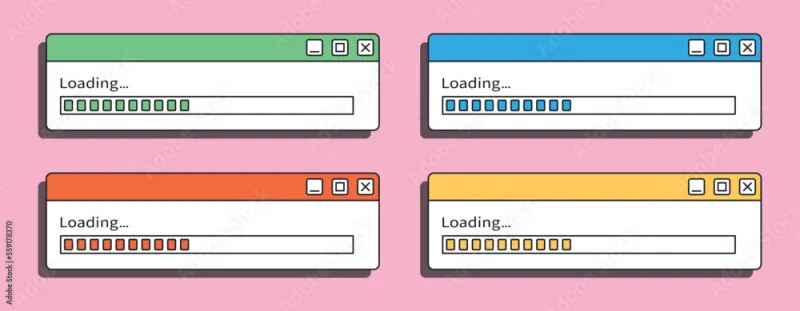
Photo: minimalist computer screen loading bar slow retro aesthetic, via as2.ftcdn.net
For much of the internet's commercial history, the loading screen was the enemy. Speed was not merely a technical preference but a moral imperative — the faster a page rendered, the more seriously its creators were taken. Latency was failure. Delay was apology.
Something has shifted.
A Brief History of Impatience
The logic that equated speed with quality was never arbitrary. In the dial-up era, slow loading times represented genuine technical limitations that frustrated users and cost businesses measurable revenue. Google's internal research famously found that even a half-second delay in search results could reduce traffic by a meaningful percentage. The entire infrastructure of content delivery networks, browser caching, and image compression exists, in large part, because engineers took that research seriously.
But infrastructure decisions made under one set of cultural conditions do not necessarily remain appropriate as those conditions change. The internet of 2025 is not the internet of 2005. The problem users face today is not scarcity of content or slowness of delivery. It is, if anything, the opposite: an environment so saturated with instantly available stimulation that the very concept of waiting has become unfamiliar — and, for a growing number of people, unexpectedly desirable.
Intentional Unoptimization
The movement — if it can be called that — toward deliberate digital slowness does not have a single origin point. It emerged from several directions simultaneously.
In the art world, a loose collection of designers and net artists began building websites that loaded slowly by design. Some used low-resolution imagery not as a concession to bandwidth but as an aesthetic statement. Others introduced artificial delays — a pause before content appeared, a gradual fade rather than an instant render — to create what they described as a sense of arrival. You did not simply access these sites. You waited for them.
The low-bandwidth art project The World's Slowest Website, which deliberately throttles its own delivery to approximate early-internet speeds, attracted considerable attention when it launched — not because it was useful, but because it was unexpectedly moving. Users reported that the experience of waiting for content to load, line by line, induced a kind of attention they had forgotten was possible online. They read more carefully. They felt, several noted, more present.
This response was not universal, and the project's creators were careful not to overstate its implications. But the pattern it revealed was significant: friction, applied deliberately, could function as a focusing mechanism.
The Psychology of the Pause
Researchers studying human-computer interaction have long understood that the relationship between effort and perceived value is nonlinear. In behavioral psychology, this is sometimes called the IKEA effect — the observation that people assign greater value to things they have participated in assembling, even minimally. Digital patience may operate on a related principle.
When a user must wait for something, the waiting itself becomes part of the experience. It creates a boundary between the mundane flow of digital consumption and the specific moment of engagement. The content, when it finally arrives, exists on the other side of an interval — and that interval, however brief, gives the content a quality of having been earned.
Anti-algorithm platforms have begun exploiting this dynamic in ways that are both deliberate and philosophically coherent. Several independent publishing platforms operating in the United States have introduced what they call friction layers — small, intentional impediments to content delivery that slow the reading experience without preventing it. One such platform requires users to complete a brief written response before accessing a long-form article, on the theory that the act of articulating why you want to read something deepens your engagement with it once you do.
These interventions are not universally welcomed. Critics argue, with some justification, that manufactured friction can become its own form of performance — a way for platforms to signal seriousness without actually delivering depth. The line between meaningful delay and mere affectation is genuinely difficult to locate.
Slowness as Community Architecture
Perhaps the most consequential dimension of this shift is its effect on community formation. Platforms that move quickly tend to attract users who value speed; platforms that move slowly tend to attract users who value deliberation. This is not a trivial distinction.
The communities that have formed around intentionally slow or unoptimized digital spaces share certain characteristics that faster platforms rarely produce: sustained conversations rather than reactive exchanges, a higher tolerance for nuance and ambiguity, and a lower incidence of the performative outrage that dominates attention-optimized environments. Whether these qualities are caused by the slowness or merely correlated with it remains an open question. But the correlation is consistent enough to warrant attention.
Voidframe exists, in some sense, at the intersection of these concerns. A site that loads quietly, that does not demand immediate engagement, that allows content to arrive at its own pace — this is not a technical limitation but an editorial position. The unexpected, as we have long maintained, deserves room to breathe.
What Waiting Reveals
The loading screen, reconsidered, is not an obstacle between the user and the content. It is a moment of suspension — a threshold state in which the user exists in anticipation rather than consumption. For decades, the industry's goal was to eliminate that state entirely. The emerging counter-argument suggests that in eliminating it, we may have eliminated something worth keeping.
The internet has never been more capable of delivering everything instantly. The more interesting question, perhaps, is what it might be worth to occasionally choose otherwise.