Error as Intention: How Broken Screens Became the New Manifesto
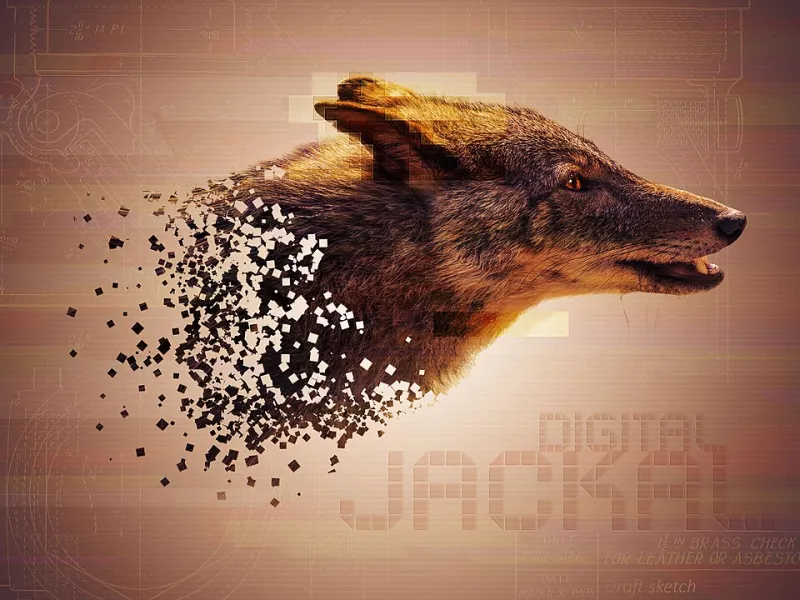
Photo: Arielinson, CC BY-SA 4.0, via Wikimedia Commons
There is a particular discomfort that arrives when a webpage loads incorrectly. Text bleeds into margins. Images fragment into horizontal bands of color. A navigation bar dissolves into something that resembles static. For most of the internet's commercial history, these moments were problems to be fixed — evidence that something had gone wrong between server and screen. Increasingly, however, they are evidence that something has gone exactly right.
The glitch aesthetic has matured from a fringe curiosity into a coherent visual and philosophical movement, one that carries specific weight among creators who came of age watching social platforms sand every rough edge into algorithmic approval. To understand why broken design is resonating now, it helps to understand what it is breaking against.
The Surface That Needed Disrupting
For roughly a decade, the dominant visual grammar of the internet has been one of radical smoothness. Rounded corners. Generous white space. Pastel palettes calibrated to reduce cognitive friction. The design philosophy that Silicon Valley exported to the rest of the digital world was predicated on a single premise: the best interface is one you do not notice. Invisible infrastructure, frictionless transactions, seamless experience.
This aesthetic was not neutral. It carried assumptions about what users wanted — or more precisely, what they should want. It optimized for engagement metrics, for time-on-site, for the conversion funnel. It was design in the service of extraction, and it wore the costume of helpfulness.
Gen Z creators, many of whom have never known a version of the internet that was not surveilled and monetized, absorbed this tension early. The glitch became available to them not merely as a visual style but as a diagnostic tool — a way of making visible the machinery that polished surfaces were designed to conceal.
What the Corruption Reveals
Artists working in glitch aesthetics often describe their practice in terms of exposure. When Portland-based digital artist communities began circulating corrupted JPEG work in the early 2020s, the conversation around it consistently returned to the idea of the image telling the truth about itself. A photograph manipulated at the data level — its hexadecimal values altered manually — does not lie about being a file. It insists on it. The artifact is the content.
This is meaningfully different from mere nostalgia for early internet aesthetics, though the two are sometimes conflated. The lo-fi revival — GeoCities fonts, blinking GIFs, early 2000s web layouts — is primarily affective, reaching backward toward a time that felt less colonized by corporate intent. Glitch art, by contrast, is more confrontational. It does not mourn a lost innocence. It interrogates the present.
Corrupted interfaces, deliberately broken layouts, and error-state designs force the viewer into an active position. When a website's navigation fails to function as expected, the user must slow down. They must look. The friction that commercial design has spent billions of dollars eliminating is reintroduced as a demand for attention.
The Corporate Smooth and Its Discontents
The critique embedded in glitch aesthetics has found particular purchase in the context of platform homogenization. As Instagram, TikTok, and their successors have imposed increasingly rigid templates on creative expression, the visual vocabulary available to individual creators has narrowed. Feeds that once reflected genuine diversity of style and intent have converged toward a recognizable aesthetic of aspirational legibility.
Against this backdrop, the deliberate introduction of visual noise reads as an act of refusal. A profile page that renders incorrectly, an artist portfolio that appears to be loading forever, a video that stutters at intervals — these are not accidents that undermine the work. They are the work. They signal that the creator has opted out of the contract that says visibility requires palatability.
This refusal carries real costs. Platforms penalize content that performs poorly by conventional metrics, and broken aesthetics rarely perform well by conventional metrics. The choice to embrace the glitch is, in many cases, a choice to accept reduced reach in exchange for something harder to quantify — integrity of form, perhaps, or simply the satisfaction of making something that resists easy consumption.
Imperfection as Infrastructure
What is perhaps most interesting about the glitch aesthetic movement is the degree of technical sophistication it often requires. Achieving a convincing, intentional corruption — one that reads as deliberate rather than merely accidental — demands a working knowledge of image formats, video codecs, and the specific ways that different file types fail. The aesthetic of breakdown is built on a foundation of competence.
This paradox is not lost on its practitioners. The work that appears most broken frequently required the most precision to produce. A glitched image that looks authentic has been carefully authored. A layout that seems to be collapsing has been constructed to collapse in exactly this way and no other. The imperfection is, in a technical sense, perfect.
This brings the movement into conversation with a longer tradition of American art that has valued the handmade, the rough, and the unfinished as markers of authenticity. Abstract expressionism's visible brushwork. Punk rock's deliberate amateurism. The zine's embrace of photocopy degradation. In each case, the rejection of polish was also an assertion of presence — evidence that a human being, with specific hands and specific intentions, had made this thing.
Reading the Static
The voidframe of the glitch aesthetic — its particular emptiness, its refusal to resolve into clarity — is precisely what gives it communicative power. When a screen breaks, it creates a gap in the expected flow of information. That gap is not meaningless. It is a space in which the viewer must supply something: attention, interpretation, patience, or simply the acknowledgment that they are looking at a constructed object rather than a transparent window.
In a media environment defined by the relentless delivery of content calibrated to eliminate any such gaps, this interruption carries weight. The glitch does not ask for your engagement. It makes engagement difficult, which is another way of saying it makes engagement real.
Whether this constitutes rebellion, art, or simply a new set of conventions waiting to be absorbed by the same commercial apparatus it critiques is an open question. Aesthetics have a way of being metabolized. But for the moment, the broken screen holds something that the smooth one cannot — the suggestion that what you are seeing has not been optimized for your approval.