Ruins in the Register: What Abandoned Websites Preserve That Living Ones Cannot
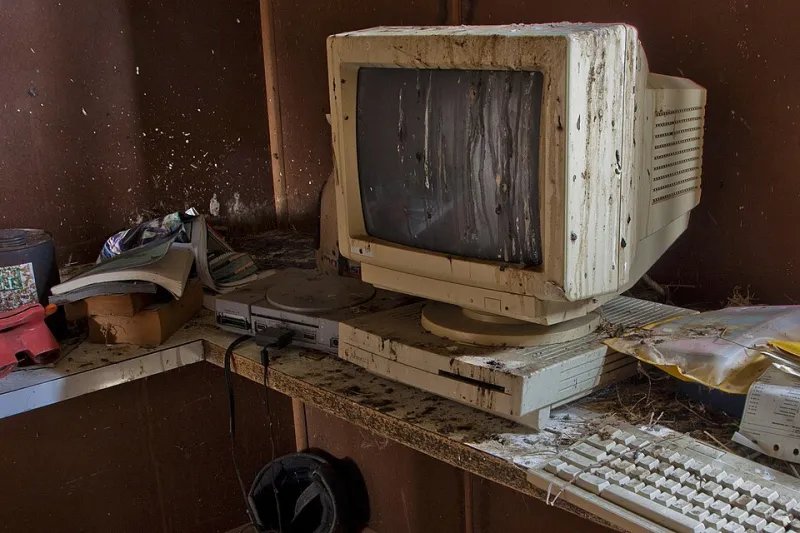
Photo: Steve Parker, CC BY 3.0, via Wikimedia Commons
There is a particular quality of stillness that settles over an abandoned website. The navigation links no longer resolve. The guestbook entries stopped accumulating sometime around 2004. A MIDI file, if your browser will still consent to play it, loops in the background like a transmission from a civilization that simply moved on without announcing its departure. These are not failures. They are fossils.
The internet, as most Americans encounter it today, is a relentlessly curated environment. Platforms optimize for engagement. Feeds surface what is new, trending, or commercially sponsored. The underlying assumption is that relevance is synonymous with recency. But scattered across aging servers, archived in the Wayback Machine's petabyte-scale vaults, and occasionally stumbled upon through misdirected links, an older internet persists—one that was built by hand, maintained by enthusiasm, and abandoned without ceremony.
These digital ruins matter more than their traffic numbers suggest.
The Archive as Anthropology
Consider what a mid-1990s personal homepage actually contains. A photograph scanned from a physical print. A list of favorite movies typed out in a font the creator chose because it felt expressive. An "about me" page written in the first person with a sincerity that contemporary social media profiles, shaped by platform conventions and audience awareness, rarely achieve. These pages were not performing for an algorithm. They were not optimized for discoverability. They were, in the most literal sense, someone's attempt to occupy space on a new frontier.
Digital archaeologists—a term used loosely but not unseriously by those who study this material—argue that abandoned websites function as primary sources in ways that living platforms do not. A website that has not been touched since 1998 cannot be retroactively edited to align with a creator's current views. It cannot be deleted because a brand partnership made an old post inconvenient. It exists in amber, preserving not just content but context: the aesthetic choices of a particular moment, the technological constraints that shaped expression, the cultural preoccupations that surfaced organically in thousands of individual pages.
The Wayback Machine, operated by the Internet Archive in San Francisco, has crawled and preserved over 800 billion web pages. That number is staggering, but it is also incomplete. The archive captures what it can reach, which means that password-protected communities, dynamically generated content, and sites that explicitly blocked crawlers have largely vanished. What survives is already a curated sample of a curated sample.
Communities Built Around Disappearance
Something unexpected has emerged around these digital ruins: communities of people who find them meaningful.
On forums, Discord servers, and dedicated wikis, groups of enthusiasts document defunct websites with a care that borders on devotion. Some focus on specific genres—the abandoned fan sites of early 2000s pop acts, the GeoCities neighborhoods that Yahoo deleted in 2009, the Flash-based gaming portals that became inaccessible after Adobe ended support for the plugin. Others operate more broadly, cataloging anything that feels worth remembering.
The motivations vary. Some participants are historians in a practical sense, concerned with documentation as an end in itself. Others are driven by personal nostalgia—they grew up with these sites and experience their disappearance as a form of loss that mainstream culture rarely acknowledges. Still others are drawn by the aesthetic qualities of early web design: the garish color combinations, the tiled backgrounds, the under-construction GIFs that promised updates no one ever delivered.
What unites these communities is an implicit argument: that the internet has a past worth preserving, and that this preservation is not happening at the institutional scale required. The Internet Archive does extraordinary work with limited resources. But it cannot replace the interpretive labor of people who understand what they are looking at—who can explain why a particular Angelfire page about professional wrestling represents something culturally specific, or why the comment sections of early food blogs reveal more about American domestic life in the mid-2000s than most journalism from the same period.
What Decay Reveals
Abandonment itself is informative. The pattern of which sites survive and which disappear is not random. Sites hosted on platforms that shut down—GeoCities, Geocities successors, various early social networks—vanished in bulk, often without warning. Sites maintained on independently owned domains sometimes persist for decades simply because the registration fees continued to clear. This means that survival correlates, at least partially, with economic resources: the person who could afford their own domain in 1999 is more likely to have left a permanent record than the person who relied on free hosting.
This is an archival problem with cultural implications. The early internet's free hosting platforms were specifically designed to lower barriers to entry. They brought in populations who would not otherwise have had a web presence—teenagers, hobbyists, people without technical backgrounds, communities with limited financial means. When those platforms closed, they took their archives with them. What remains is already skewed toward those with the means to pay for permanence.
The Geocities Research Institute and similar volunteer-run projects have worked to recover and publish what was salvaged before the deletion. But recovery is not the same as curation, and curation is not the same as interpretation. The raw files exist. The work of understanding what they mean is largely still ahead of us.
The Ethics of Looking
There is an uncomfortable dimension to digital archaeology that practitioners acknowledge with varying degrees of directness. These sites were made by people who are, in many cases, still alive. The teenager who built a shrine to their favorite band in 1997 is now in their forties. They may have no idea their page still exists, indexed and accessible, preserving opinions and enthusiasms they have long since moved past.
The question of consent is genuinely unresolved. Publishing on the early web was an act of public expression, but the expectation of permanence was not always part of that act. Many creators assumed their pages would simply fade away when they stopped paying attention. The fact that archival efforts preserved them is, from one perspective, a gift to future researchers. From another, it is a form of indefinite retention that the original creators never agreed to.
This tension does not have a clean resolution. It does, however, suggest that the communities forming around digital preservation have obligations beyond cataloging—obligations toward context, toward the humanity of the people whose work they are preserving, and toward honesty about what they do and do not know.
What Persists
The internet's ruins are not static. They are slowly disappearing as servers are decommissioned, domains expire, and the files that once constituted a person's online presence are quietly overwritten. The window for preservation is not infinite.
But there is something clarifying about engaging with these spaces—something that the living, optimized, engagement-maximized internet rarely offers. A dead website asks nothing of you. It does not track your behavior or adjust its presentation based on your history. It exists as it was made, in a specific moment, by a specific person, for reasons that may or may not be apparent. That quality of fixity, in an environment defined by constant flux, is rarer and more valuable than it might initially appear.
The voids left by abandoned websites are not empty. They are full of what the current internet has largely chosen to forget.