Set Your Watch by Nothing: The Quiet Power of Sites That Keep Their Own Time
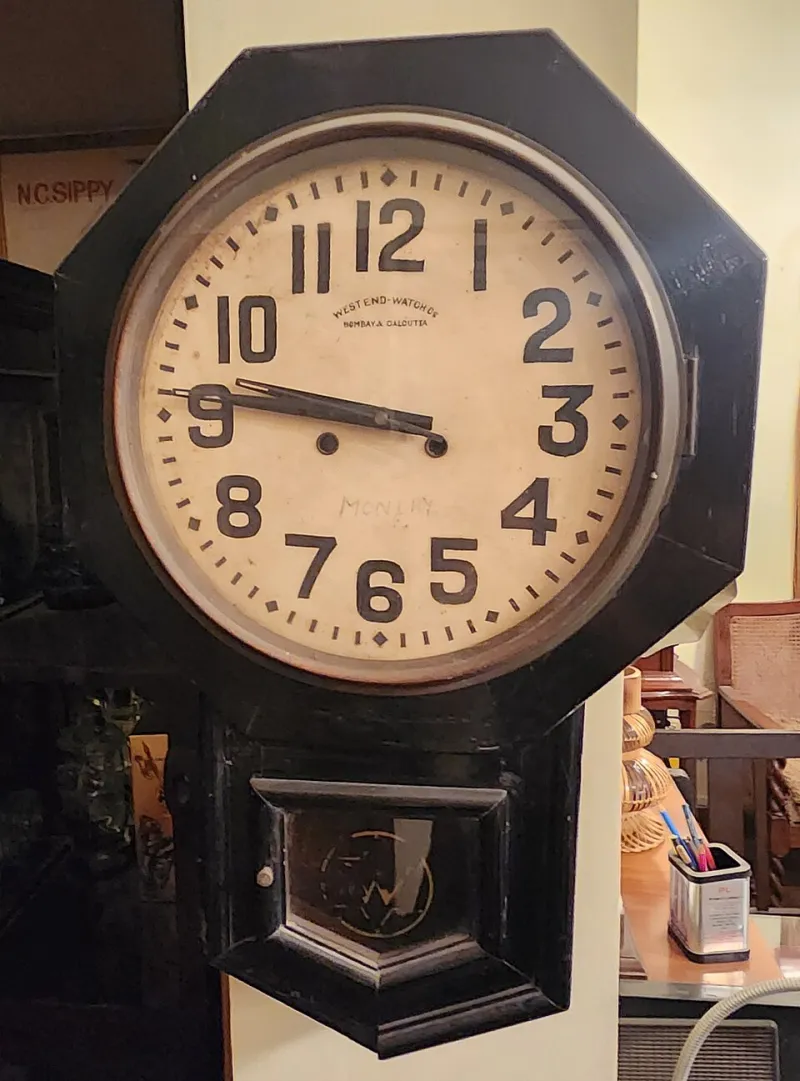
Photo: Amitbalani, CC0, via Wikimedia Commons
There is a clock in the corner of the page, and it is wrong. Not dramatically — four minutes, perhaps five — but wrong in a way that becomes difficult to unsee once noticed. It has hands. It ticks. It sits at the edge of a site that offers almost nothing else: a short paragraph of text, one link, a background the color of an unlit room. And it is not synced to anything in particular.
Visitors who care about such details check it against their phones. They reload. The drift holds. Whoever built the page either abandoned the synchronization script years ago or declined to write one in the first place, which means the clock has been running on the browser's own uncertain sense of the hour ever since.
Most of the web treats time as a service. Countdown timers, session expirations, and posted-three-hours-ago labels all exist to keep the visitor oriented, and their accuracy is the entire point: a clock that cannot be trusted is a clock that has failed. The drifting clock in the corner belongs to a different tradition. It is not reporting the time. It is reporting that there is a time, and that this place has its own.
The Last-Updated Stamp as Atmosphere
Consider the revised-on line that appears at the foot of so many sparse pages. On a newsroom site or a documentation hub, that line is a fact. It tells you whether the page is current, whether the contact details still work, whether the advice is still safe to follow. On a handmade site with no author's name and no archive, the same line behaves more like weather. Revised March 1999. Updated occasionally. Last checked some time ago.
None of these are useful. All of them are expressive. The stamp tells you that someone was here, that someone cared enough to note the passing of their own attention, and that the record of that attention is now itself aging. It is a signature written in the only unit of measurement the web actually possesses: elapsed time.
Designers who use these lines well understand that a date can do the work of a whole paragraph of description. A page stamped with a date from the previous decade announces its temperament before you have read a sentence. It says: this is a place that was built and then left to keep its own hours.
Why Drift Reads as Life
Precision, oddly, is what makes a site feel automated. A timestamp resolved to the millisecond, adjusted for the visitor's locale, converted into two minutes ago, is the language of a system that knows exactly when you arrived and would like you to know it knows. There is something faintly surveillance-adjacent about the whole exchange — a reminder that your presence has been logged and indexed.
Imprecision reads as human. A clock running a few minutes fast suggests a person who set it once and never bothered again. A stamp that says recently suggests an author with a life outside the server. A countdown that quietly resets at midnight rather than expiring suggests something arranged — not by a content system, but by a person with a sense of humor about deadlines.
This is the whole trick of temporal weirdness on the web: it produces the impression of an interior. Machines are punctual. Buildings are not. Anyone who has lived in an old house knows the feeling of a clock that has been fast for thirty years, and the small, affectionate arithmetic one performs to accommodate it. A site can manufacture that accommodation. Once you know the clock is five minutes ahead, you start doing the subtraction yourself — and in doing so, you have quietly agreed to participate in the site's version of reality.
Countdowns That Refuse to Conclude
The most interesting temporal devices are the ones that will not end. A countdown to an event is a promise; a countdown that returns to its starting value when it reaches zero is a mood. Some sites run a loop that resets without explanation. Others display a date that has already passed, or one far enough in the future that no visitor can verify it.
The effect is not always sinister. In careful hands, a looping timer reads as patience — a placeholder for something that will happen when it happens. In less careful hands it reads as a trap, and the visitor's suspicion is reasonable. Time pressure is among the oldest persuasion techniques on the internet, and a countdown that cannot be checked is a countdown that cannot be falsified.
Suspicion Is Half the Pleasure
Which brings us to the ambivalence that surrounds any site keeping its own time. The visitor cannot tell, from the clock alone, whether the drift is an artifact of neglect, an aesthetic decision, or a piece of theater. That ambiguity is not a flaw in the design. It is the design.
A page that reports the correct hour in the correct format has told you everything about itself in advance. A page whose clock is nine minutes slow has left a question open: who set this, and when, and why has no one fixed it? The question is cheap to ask and hard to answer, which is precisely the kind of question that makes a sparse site worth returning to. It rewards the visitor who notices, and it costs nothing to the visitor who does not.
There is also a subtler effect at work. Time is the one resource a website cannot give back. When a page insists on its own clock, it gently declines to share yours. For a few seconds, the visitor is not operating on the schedule of the network but on the schedule of the room they have walked into — a room with a slow clock and no explanation for it.
The clock in the corner is still wrong. It is also, in its small way, the most honest object on the page. It does not claim to be your clock. It only claims to be a clock, one that has been there longer than you and will keep ticking after you close the tab, at whatever hour it has decided is correct.